IRS Form 2290: The Complete Filing Guide
Who must file Form 2290, what the Heavy Vehicle Use Tax (HVUT) costs, when it is due, what you need before you start, and how to e-file for your IRS-stamped Schedule 1.
Last reviewed October 18, 2026 against the IRS Instructions for Form 2290 (July 2026). See sources
Watch: Filing Form 2290 with Send 2290
What is IRS Form 2290?
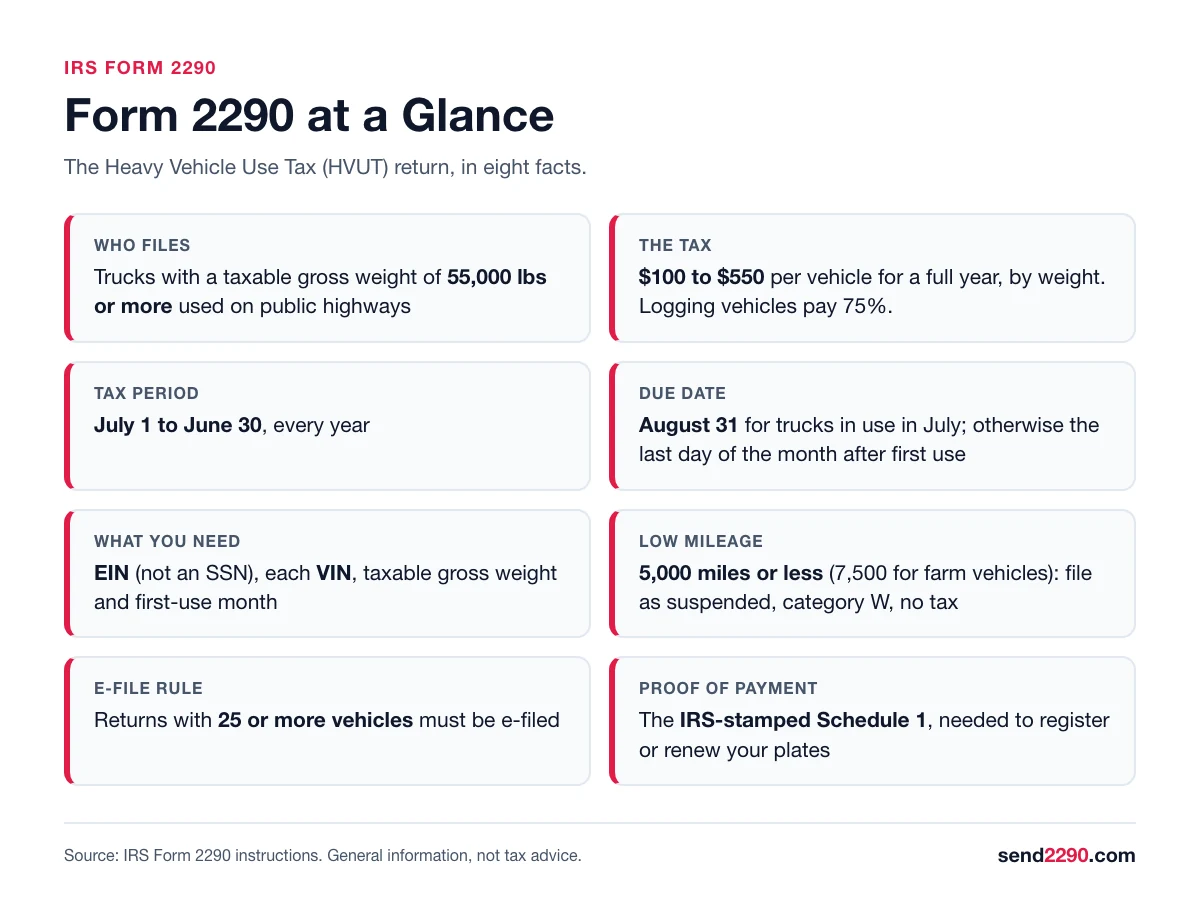
IRS Form 2290, officially titled “Heavy Highway Vehicle Use Tax Return,” is a federal tax form used to report and pay the Heavy Vehicle Use Tax (HVUT). This tax applies to highway motor vehicles with a taxable gross weight of 55,000 pounds or more that are used on public highways.
The HVUT is an annual tax that helps fund the Federal Highway Trust Fund, which pays for highway construction and maintenance across the United States. When you file Form 2290 online and pay the tax, you receive a stamped Schedule 1 as proof of payment—a document required for vehicle registration, plate renewal, and crossing international borders.
Looking for the Spanish version? El Formulario 2290 es el documento del IRS para reportar y pagar el impuesto por uso de vehículos pesados (HVUT). Con Send 2290, puedes completar tu Formulario 2290 en línea y obtener tu Schedule 1 sellado en minutos.
Who Must File Form 2290?
You must file Form 2290 and pay the heavy vehicle use tax if a highway motor vehicle registered (or required to be registered) in your name has a taxable gross weight of 55,000 pounds or more. Taxable gross weight is the empty weight of the truck and any trailers it customarily pulls, plus the heaviest load it customarily carries — not just the truck's own weight.
Must File Form 2290:
- ✓Trucks and truck tractors at 55,000 lbs or more
- ✓Buses at 55,000 lbs or more (weight is what counts, not seat count)
- ✓Owner-operators and fleets alike — one return can cover many vehicles
- ✓Suspended vehicles (5,000 miles or less) — no tax, but they still must be reported
Exempt from HVUT:
- ✗Vehicles under 55,000 lbs taxable gross weight
- ✗Federal, state, local and District of Columbia government vehicles
- ✗American National Red Cross; nonprofit volunteer fire departments, ambulance associations and rescue squads
- ✗Indian tribal governments (essential government functions only) and qualifying mass transportation authorities
- ✗Qualified blood collector vehicles and qualifying mobile machinery
2290 Tax Rates by Vehicle Weight
The HVUT 2290 tax amount depends on your vehicle's taxable gross weight (TGW). The tax year runs from July 1 to June 30. Here are the current annual tax rates:
| Category | Taxable Gross Weight | Annual Tax |
|---|---|---|
| A | 55,000 lbs | $100 |
| B | 55,001 – 56,000 lbs | $122 |
| C | 56,001 – 57,000 lbs | $144 |
| D | 57,001 – 58,000 lbs | $166 |
| E | 58,001 – 59,000 lbs | $188 |
| F | 59,001 – 60,000 lbs | $210 |
| G | 60,001 – 61,000 lbs | $232 |
| H | 61,001 – 62,000 lbs | $254 |
| I | 62,001 – 63,000 lbs | $276 |
| J | 63,001 – 64,000 lbs | $298 |
| K | 64,001 – 65,000 lbs | $320 |
| L | 65,001 – 66,000 lbs | $342 |
| M | 66,001 – 67,000 lbs | $364 |
| N | 67,001 – 68,000 lbs | $386 |
| O | 68,001 – 69,000 lbs | $408 |
| P | 69,001 – 70,000 lbs | $430 |
| Q | 70,001 – 71,000 lbs | $452 |
| R | 71,001 – 72,000 lbs | $474 |
| S | 72,001 – 73,000 lbs | $496 |
| T | 73,001 – 74,000 lbs | $518 |
| U | 74,001 – 75,000 lbs | $540 |
| V | over 75,000 lbs | $550 |
Note: Logging vehicles pay a reduced rate. Vehicles first used after July pay a prorated (partial-period) amount — the HVUT calculator works it out by weight and first-use month.
How to File Form 2290 Online, Step by Step
What you need before you start
- • Your EIN — the IRS does not accept a Social Security Number on Form 2290
- • Your business name and address exactly as the IRS has them for that EIN
- • The 17-character VIN of each vehicle
- • Each vehicle's taxable gross weight and the month it was first used on public highways this tax period
- • A way to pay the tax: direct debit from a bank account, EFTPS, or a credit or debit card
- Create an account and enter your EIN with an IRS-authorized e-file provider.
- Enter your business and vehicle details — name, address, each VIN and weight. Fleets can upload a spreadsheet.
- Review the tax calculated for each weight category, and mark any suspended (low-mileage) vehicles.
- Choose how to pay the IRS and submit the return electronically.
- Download your stamped Schedule 1 once the IRS accepts the return — usually within minutes.
The two most common reasons a return is rejected
- • A brand-new EIN. An EIN issued online works right away for some purposes, but the IRS e-file system can take a few weeks to recognize it — the IRS says to allow up to four weeks. A return filed before then is often rejected; waiting and resubmitting usually fixes it. What to do if your EIN is not active yet
- • A name that doesn't match IRS records. The IRS checks your EIN against the business name it has on file. Enter the legal name exactly as it appears on your EIN confirmation letter, not a nickname or a new trade name.
Form 2290 Due Dates
The tax period runs July 1 through June 30. Vehicles on the road in July are due by August 31. A vehicle first used later in the year is due by the last day of the following month — for example, first used in September, due October 31. A due date on a weekend or legal holiday moves to the next business day.
Every deadline by first-use month is on our Form 2290 due dates page.
Ready to File Your Form 2290?
Get your IRS-stamped Schedule 1 in as fast as 3 minutes.
What is Schedule 1?
Schedule 1 lists the vehicles on your return. Once the IRS accepts the return, the stamped copy is your proof that the HVUT was paid (or that a vehicle is suspended). States ask for it to register a heavy vehicle or renew its plates, and U.S. Customs and Border Protection asks for it when a Canadian or Mexican vehicle enters the United States.
E-filing returns the stamped copy electronically, usually within minutes of acceptance; a paper return can take weeks. More on getting, checking and replacing it: Schedule 1 proof of payment.
VIN Corrections on Form 2290
If a VIN on an accepted return is wrong — a typo, transposed characters, or a partial VIN — you file a VIN correction to get a new stamped Schedule 1 with the right number. No additional tax is due. This is usually what you need when a state won't register the vehicle because the VIN on Schedule 1 doesn't match the title. VIN corrections are free for returns filed through Send 2290.
Step-by-step instructions, plus the weight-increase and mileage-limit amendments: Form 2290 VIN correction & amendments.
Form 2290 Amended Returns (Weight Increase)
A 2290 amended return is required when your vehicle's taxable gross weight (TGW) increases during the tax period, moving it into a higher tax category. This is different from a VIN correction.
When to File an Amended Return:
- •You added a heavier trailer configuration
- •Vehicle modifications increased gross weight
- •You now haul heavier loads exceeding original TGW
- •A suspended vehicle exceeded 5,000 miles
Amended Return Tax Calculation:
When filing an amended return for a weight increase, figure the additional tax from the IRS Partial-Period Tax Tables: find the month the weight increased, read the tax for the new category, read the tax for the category you originally reported, and subtract. Report the difference on Form 2290, line 3, check theAmended Return box, and write the month the weight increased beside it.
Example: originally filed at 72,000 lbs (category R) → increased to 75,000 lbs (category U) in October
Partial-Period Tax Table, October: category U = $405.00, category R = $355.50
Additional tax = $405.00 − $355.50 = $49.50, due by November 30
Suspended Vehicles (Under 5,000 Miles)
A suspended vehicle is a highway motor vehicle that you expect to operate 5,000 miles or less (7,500 miles for agricultural vehicles) during the tax period. Suspended vehicles must still be reported on Form 2290, but no tax is due.
Standard Vehicles
5,000 miles
If you operate 5,000 miles or less on public highways, you qualify for suspended status with $0 tax.
Agricultural Vehicles
7,500 miles
Qualified agricultural vehicles get a higher mileage threshold of 7,500 miles for suspended status.
Exceeding the Mileage Limit
If a suspended vehicle exceeds the mileage limit during the tax period, you must file an amended Form 2290 and pay the full HVUT tax for that vehicle. The tax is due by the last day of the month following the month you exceeded the limit.
Form 8849 – HVUT Credit Claims & Refunds
IRS Form 8849 (Claim for Refund of Excise Taxes) Schedule 6 is used to claim a credit or refund for HVUT paid on Form 2290. You may be entitled to a refund in several situations.
When to File Form 8849 for HVUT Credit:
- •Vehicle sold: Claim credit for remaining months if vehicle was sold before the tax period ended
- •Vehicle destroyed: Total loss, theft, or complete destruction of the vehicle
- •Vehicle stolen: Claim credit for months after the vehicle was stolen
- •Low mileage: Vehicle used 5,000 miles or less during entire tax period
- •Overpayment: You paid more HVUT than required
Note: You can also claim a credit on a subsequent Form 2290 instead of filing Form 8849 for a refund. This applies the credit to your next year's tax liability.
How to Pay Your 2290 Tax Online
The IRS accepts four ways to pay the HVUT. The tax is paid to the IRS, separately from any e-file provider fee:
Direct Debit (Electronic Funds Withdrawal)
Authorize the IRS to debit your bank account as part of the e-filed return.
- ✓ No IRS fee
- ✓ Available only when you e-file
- • Have your routing and account numbers ready
Credit/Debit Card
Pay through one of the IRS-approved card processors.
- ✓ Major cards accepted
- • The processor charges its own fee, a percentage of the payment
- • Current processors and fees are listed at IRS.gov/payments
EFTPS (Electronic Federal Tax Payment System)
IRS's free payment system. Requires advance enrollment.
- ✓ No processing fees
- ✓ Schedule payments in advance
- • Enrollment takes 5-7 business days
Check or Money Order
Mail a check or money order with the Form 2290-V payment voucher. Slowest option.
- ✓ No bank details shared online
- • Payable to “United States Treasury”
- • Must be mailed separately from an e-filed return
Fleet Filing: Multiple Vehicles on One Return
For 2290 fleet filing, vehicles first used in the same month go on a single Form 2290 return. Vehicles first used in different months need a separate return for each month.
25 or more vehicles? The IRS requires you to e-file any return reporting and paying tax on 25 or more vehicles. Suspended (Category W) vehicles don't count toward the 25, because no tax is paid on them.
Fleet Filing Benefits:
- ✓Bulk upload: Upload all VINs via CSV spreadsheet
- ✓Single payment: Pay total HVUT for all vehicles at once
- ✓Combined Schedule 1: Receive one document listing all vehicles
- ✓Flat pricing: charged per filing, not per vehicle — see pricing
- ✓Centralized records: All filings in one account dashboard
Send 2290 supports unlimited vehicles per return. Whether you have 5 trucks or 500, our platform handles your 2290 fleet filing efficiently.
Form 2290 Penalties & Interest
Filing or paying late can result in significant 2290 penalties. The IRS assesses both failure-to-file and failure-to-pay penalties.
Failure to File Penalty
4.5% per month
Up to 22.5% of unpaid tax (5 months maximum). Applied when Form 2290 is filed after the due date.
Failure to Pay Penalty
0.5% per month
Up to 25% of unpaid tax. Applied when tax payment is received after the due date.
Additional Consequences:
- • Interest: Charged on unpaid tax from due date until paid (IRS rate, compounded daily)
- • Registration issues: your state can refuse to register the vehicle or renew its plates without a stamped Schedule 1
- • U.S. entry: Canadian and Mexican vehicles need proof of HVUT payment to enter the United States
- • Penalty relief: if you had reasonable cause for filing or paying late, you can ask the IRS to remove the penalty
Frequently Asked Questions About Form 2290
Get answers to the most common questions about HVUT filing, Schedule 1, VIN corrections, amended returns, and more.
File Form 2290 online in under 5 minutes through an IRS-authorized e-file provider. Enter your EIN, business information, and vehicle details (VIN, taxable gross weight), calculate the Heavy Vehicle Use Tax (HVUT), choose how to pay the IRS (direct debit, EFTPS, or card), and download your stamped Schedule 1 once the IRS accepts the return, usually within minutes.
Have more questions about filing Form 2290 or HVUT 2290? Our IRS 2290 customer support team is here to help with your 2290 tax filing.
IRS Sources
This guide was last reviewed on October 18, 2026 against these official IRS pages. Where they differ from anything here, the IRS wins.
Keep Learning: Related 2290 Guides
File with Confidence
IRS-authorized and BBB listed for your peace of mind

What Our Customers Say
Reviews for Send 2290 are collected and verified by Trustpilot.
Ready to File IRS Form 2290 Online?
Start your return now, submit electronically to the IRS, and download your stamped Schedule 1 in minutes. VIN corrections, amended returns, fleet filing, and more—all in one platform.